
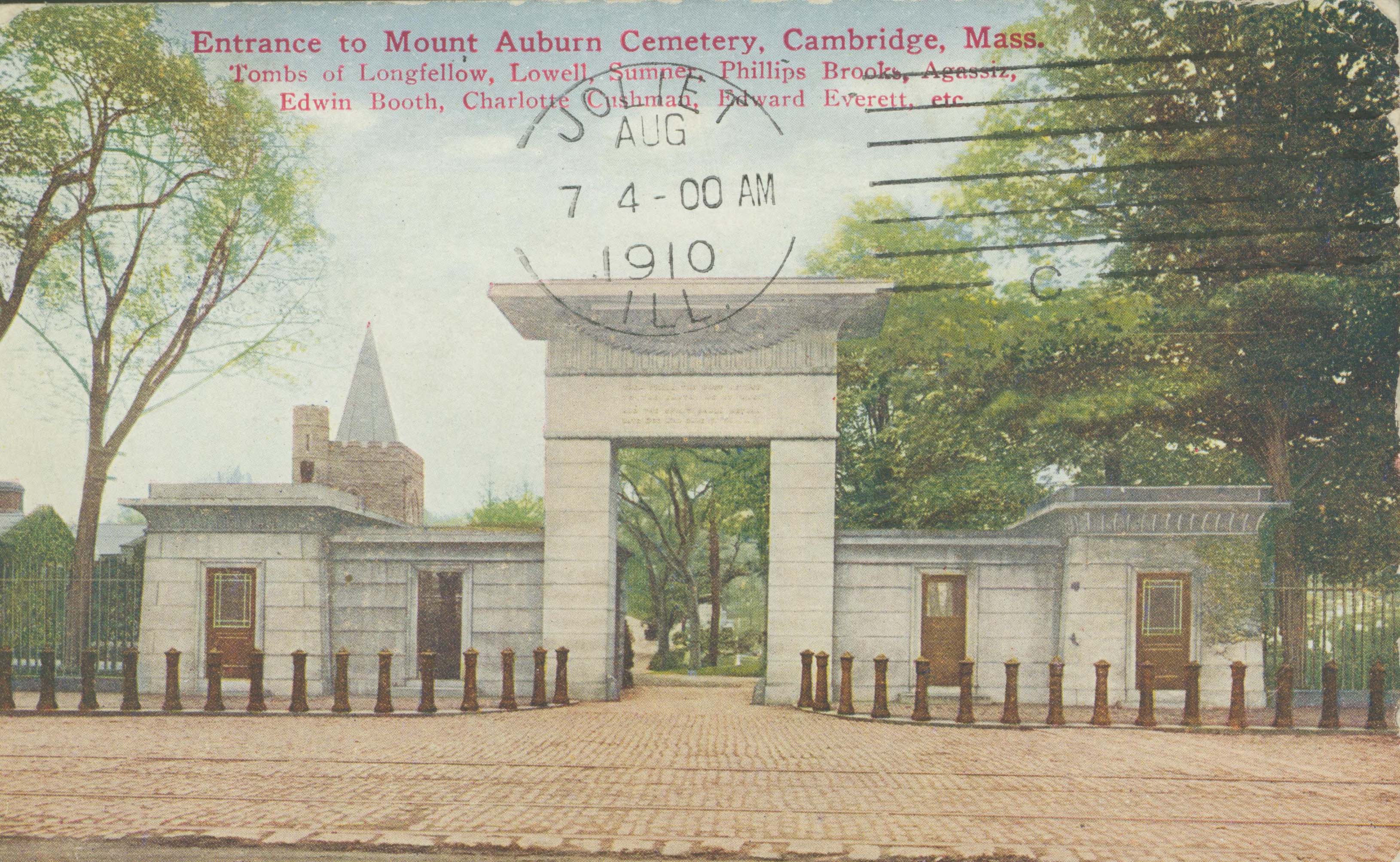
Egyptian Revival Gateway: Welcoming Visitors to Mount Auburn Cemetery
Mount Auburn Cemetery was founded for the commemoration of the dead, but also for the comfort and solace of the living. The Egyptian Revival Gatehouse was built for visitors just one year after the Cemetery’s founding, first built of wood in 1832 and later re-built of granite. It represents the passage between two worlds – from the city of living outside the Cemetery, to the peaceful city of the dead within. Most graveyards at the time had simple wooden gates or doorways for an entrance. Just as Mount Auburn was a new American landscape, its Egyptian Revival Gatehouse was the first of its kind in an American cemetery and it quickly became a model which inspired other cemeteries. Dr. Jacob Bigelow designed a Gatehouse for Mount Auburn that was grand and monumental. It was so large that it took a team of 90 oxen to pull the cornice stone approximately 15 miles from Quincy, MA, to the Cemetery. The historic Egyptian Revival Gatehouse continues to welcome visitors to Mount Auburn Cemetery. From 19th century families arriving in horse-drawn carriages to today’s visitors who gather with friends before a morning of bird watching, the Egyptian Revival Gatehouse remains the face of Mount Auburn.
Timeline
1831 Mount Auburn Cemetery consecrated on September 24. Over 2,000 visitors attended the dedication and Mount Auburn immediately became a popular destination.
1832 Egyptian Revival Gateway constructed of wood. Dr. Jacob Bigelow designs an entrance gateway inspired by ancient Egyptian structures. The wooden gateway was painted in imitation of stone, and was reconstructed in stone once the Cemetery was able to raise the funds.
1833 Entrance regulated. Wooden posts and rails are built in front of the Gatehouse, outside Mt. Auburn, for visitors to tie their horses. Later the posts were replaced in iron. Horseback riders are not allowed to enter the Cemetery. Carriages enter through the central portal and pedestrians enter at each side of the lodges where the gatekeeper and superintendent have offices. For a period of time tickets were issued to lot proprietors for admittance in carriages. Today Mount Auburn Cemetery is open 365 days a year, free of charge.
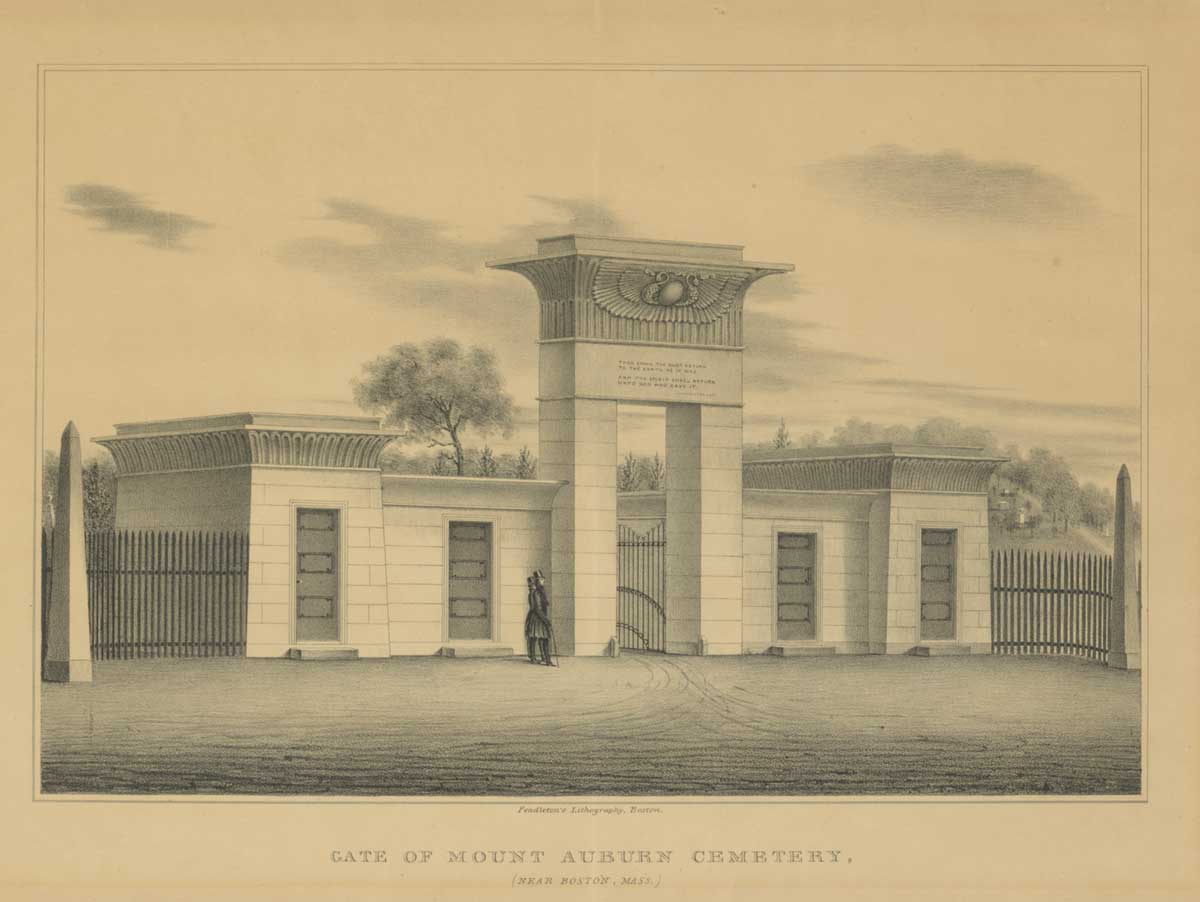
Gate of Mount Auburn Cemetery, ca. 1834 lithograph by William S. Pendleton, depicting wooden entrance gate.
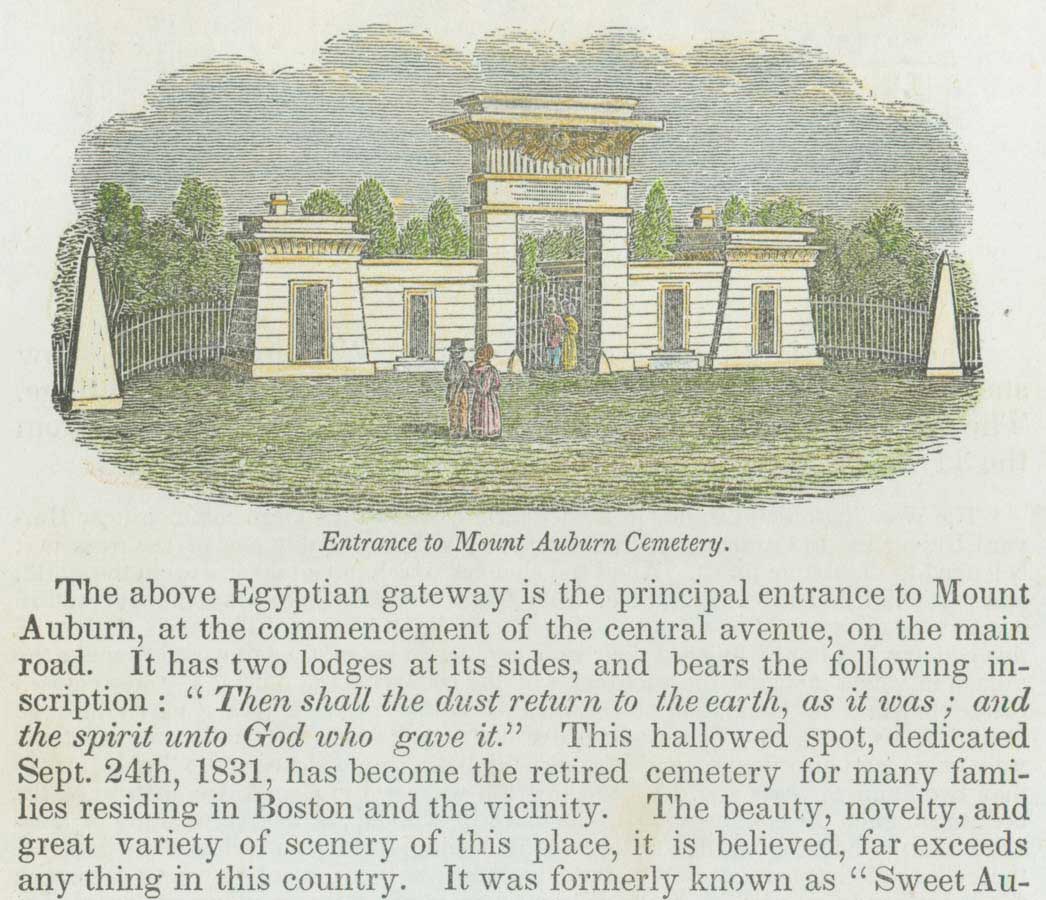
Wooden Egyptian Revival Gatehouse. 1839 woodcut print from John Warner Barber in Historical Collections…. from the State of Massachusetts. Published by Dorr, Howland & Co.,Worcester
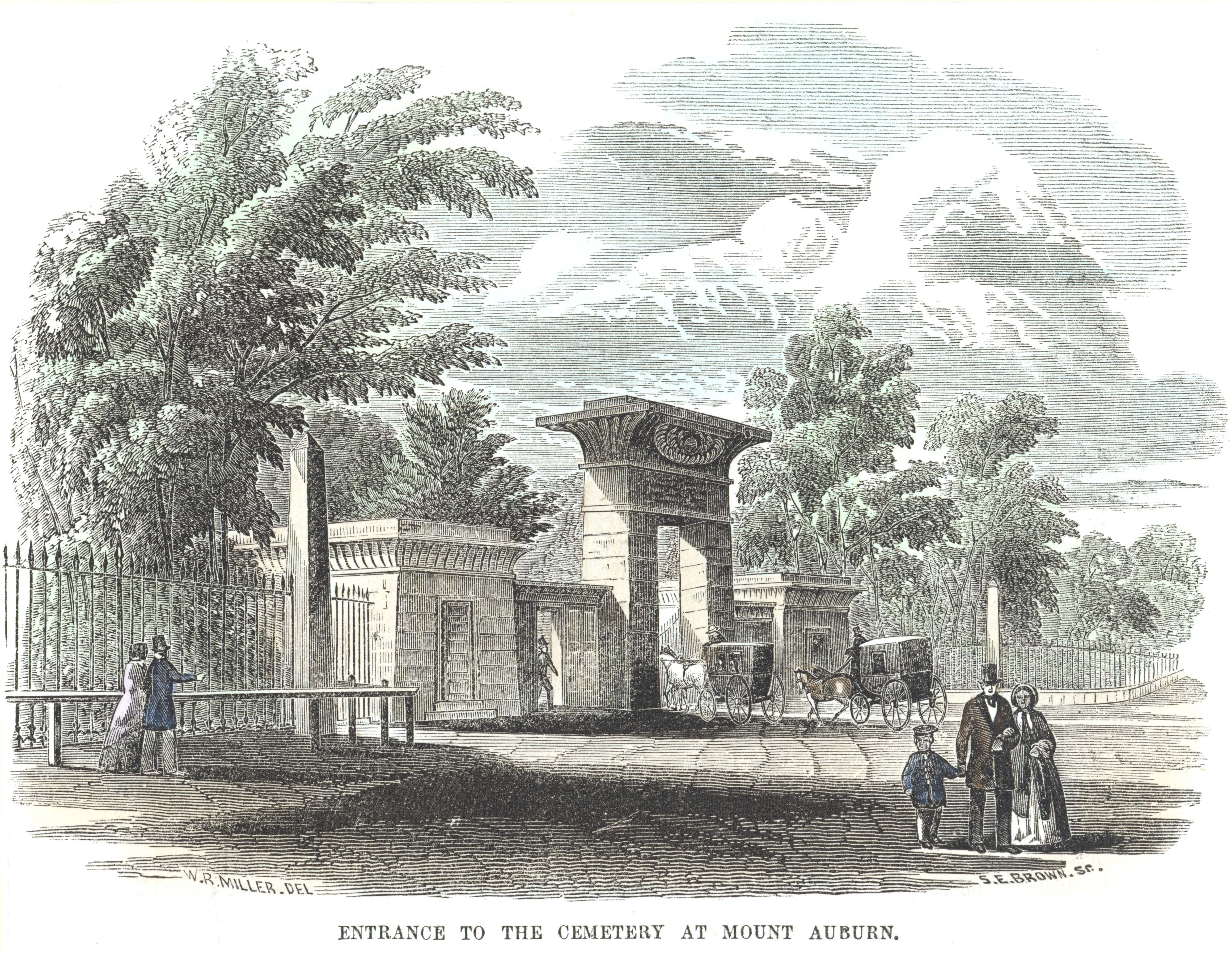
Gatehouse before the roof alcoves. 1853 Woodcut print with watercolor by W.R. Miller and S.C. Brown in Gleason’s Drawing-Room Companion. Notice the absence of the roof where the man exits the doorway to the left of the central gate.
1838 Visitors continue to enjoy Mount Auburn Cemetery. By this time, several horse-drawn omnibus lines offer hourly runs between Harvard Square and the Cemetery. The route to the Cemetery is so popular that the town of Cambridge renames the road “Mount Auburn Street,” and Watertown soon follows suit.
1842-43 Egyptian Revival Gateway re-built of Quincy granite. The Cemetery contracts Octavius T. Rogers, of Quincy, the only contractor willing to build the monumental structure. Perhaps the greatest challenge to Rogers was the carving and transportation of the 24 foot long cornice stone, about the length of two cars. Imagine the scene as 90 oxen pulled this massive piece of stone from Quincy, Mass to the Cemetery. At the time, this was likely the largest single piece of carved granite placed in a built structure in the United States.
1844 Iron fence contracted. A curved fence is constructed over several years extending from the lodges to the obelisks, as well as straight fencing enclosing the north and east sides of the Cemetery.
1856 The Cambridge Horse Railroad, the first in New England, extends its service from Bowdoin Square in Boston through Cambridge to Mount Auburn. Its cars make 175 trips each way, every day, at 15-minute intervals until 11:30 PM. Wrought-iron rails assure a smooth ride along tree-lined Brattle Street. In 1863 another line brought visitors past Fresh Pond to Mount Auburn via Garden and Craigie Streets.
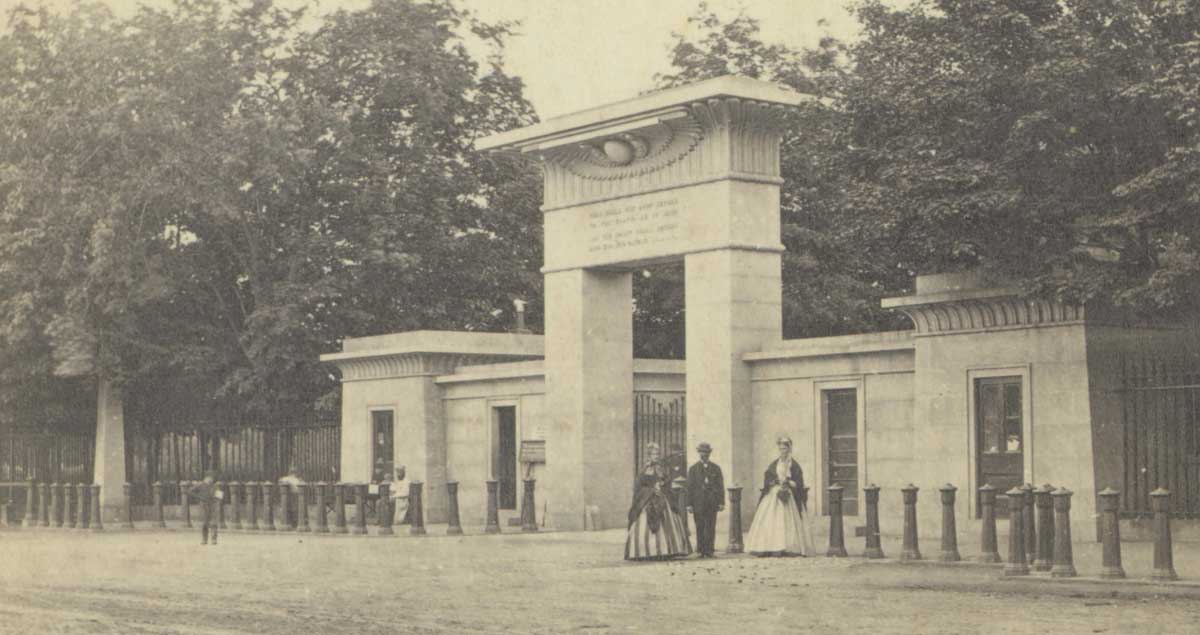
Visitors by Gatehouse. Middle to late 19th-century stereo view of the Egyptian Revival Gatehouse titled Gateway, Mt. Auburn by American Stereoscopic Co, NY.
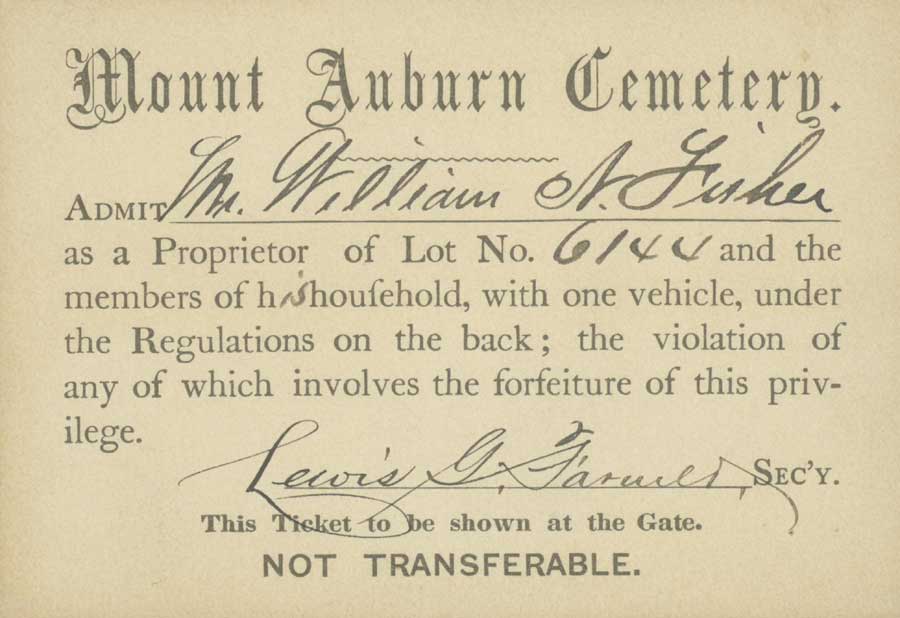
Admittance Ticket. Mid 19th-century ticket that admits the owner of lot 6144 Hydrangea Path into the Cemetery.
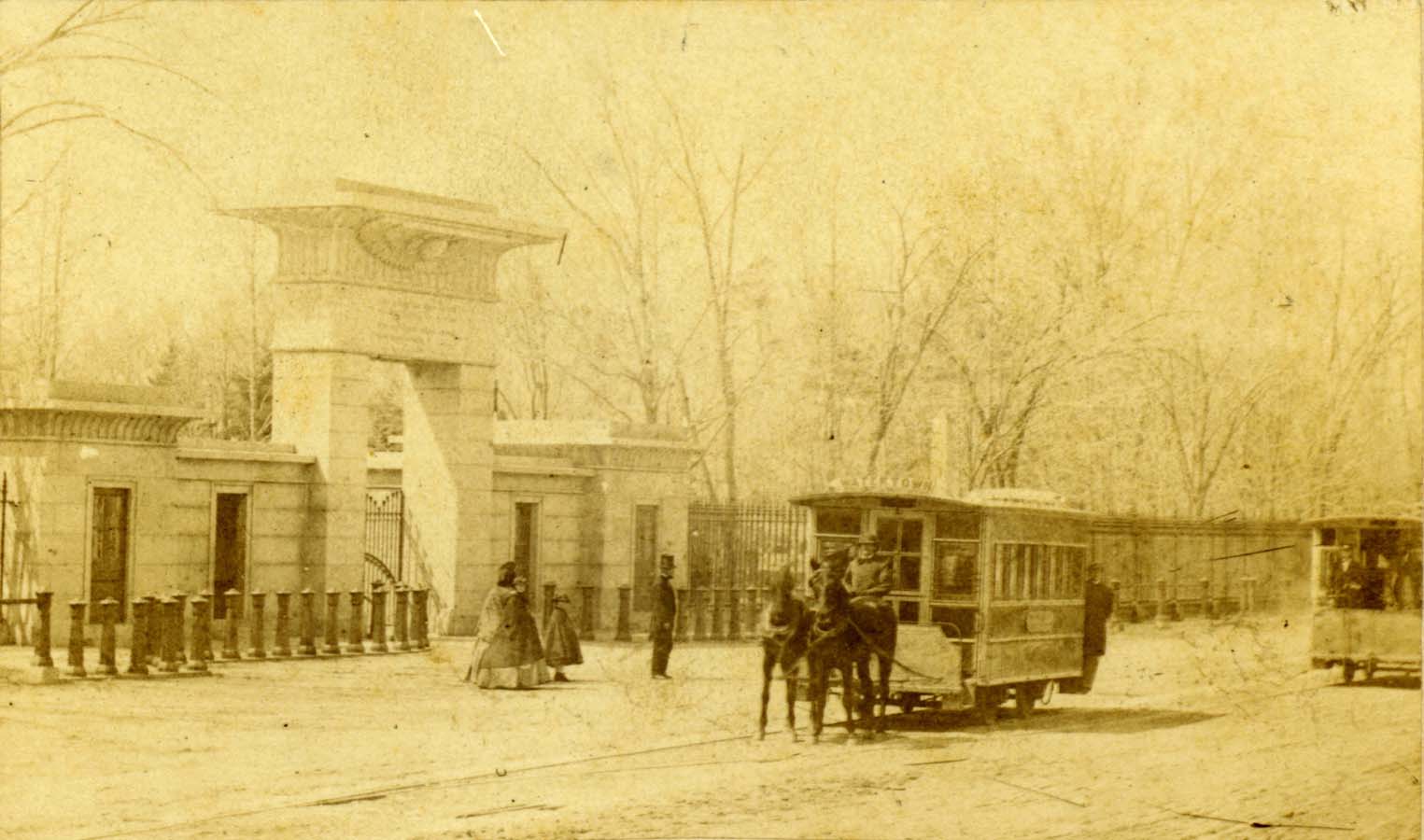
Horse Omnibus and Visitors. Mid 19th-century carte-de-viste photograph
1859 Iron fence repainted and repaired. Maintenance and repairs are required just 15 years after the fence was initially constructed.
1861 Visitor experience enhanced. Jacob Bigelow designs modifications of the Gateway to provide visitors with shelter from the sun and rain. Granite roofs, supported by carved granite columns, are installed over the previously exposed interior alcoves.
1908 Automobiles allowed into the Cemetery. And in 1913, additional gates are added on each side of the main entrance to accommodate automobiles.
1910 Turnstiles installed, in order for pedestrians to exit the Cemetery after the gates are closed.
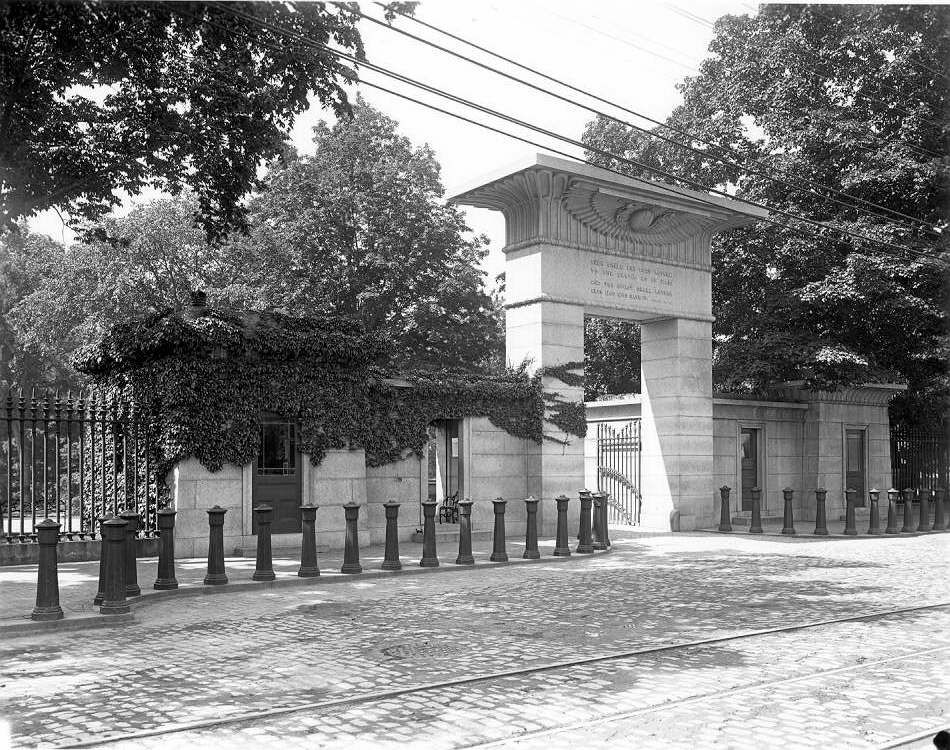
Immediately before the Turnstiles were Installed. ca 1910 photograph from the Thomas Warren Sears Collection, the Smithsonian Institution. Notice that the turnstiles have not yet been located next to the lodges of the Gateway.
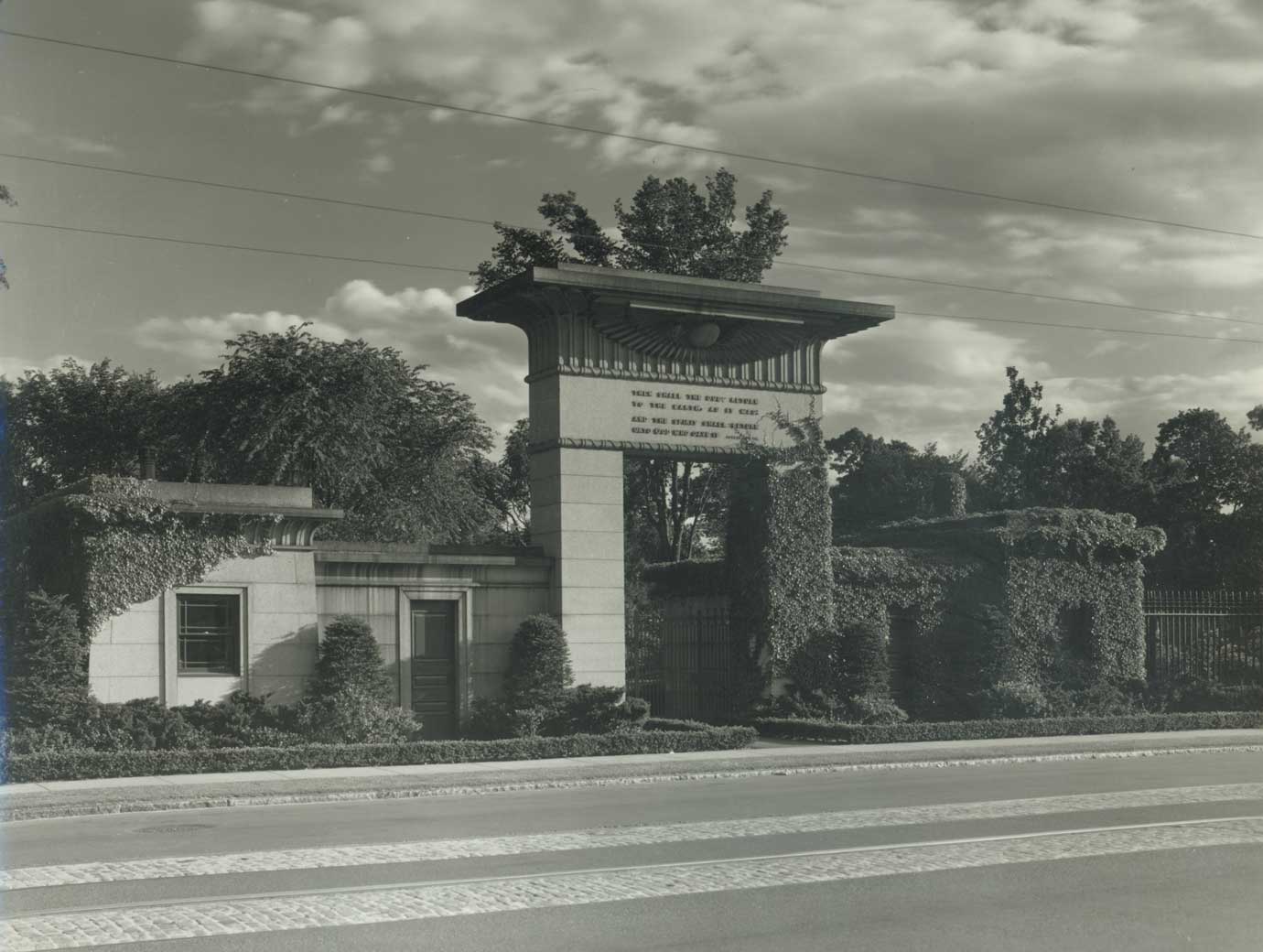
Horticulture and the Gatehouse. Ca. 1945 photographic prints by Arthur C. Haskell. View from street side.
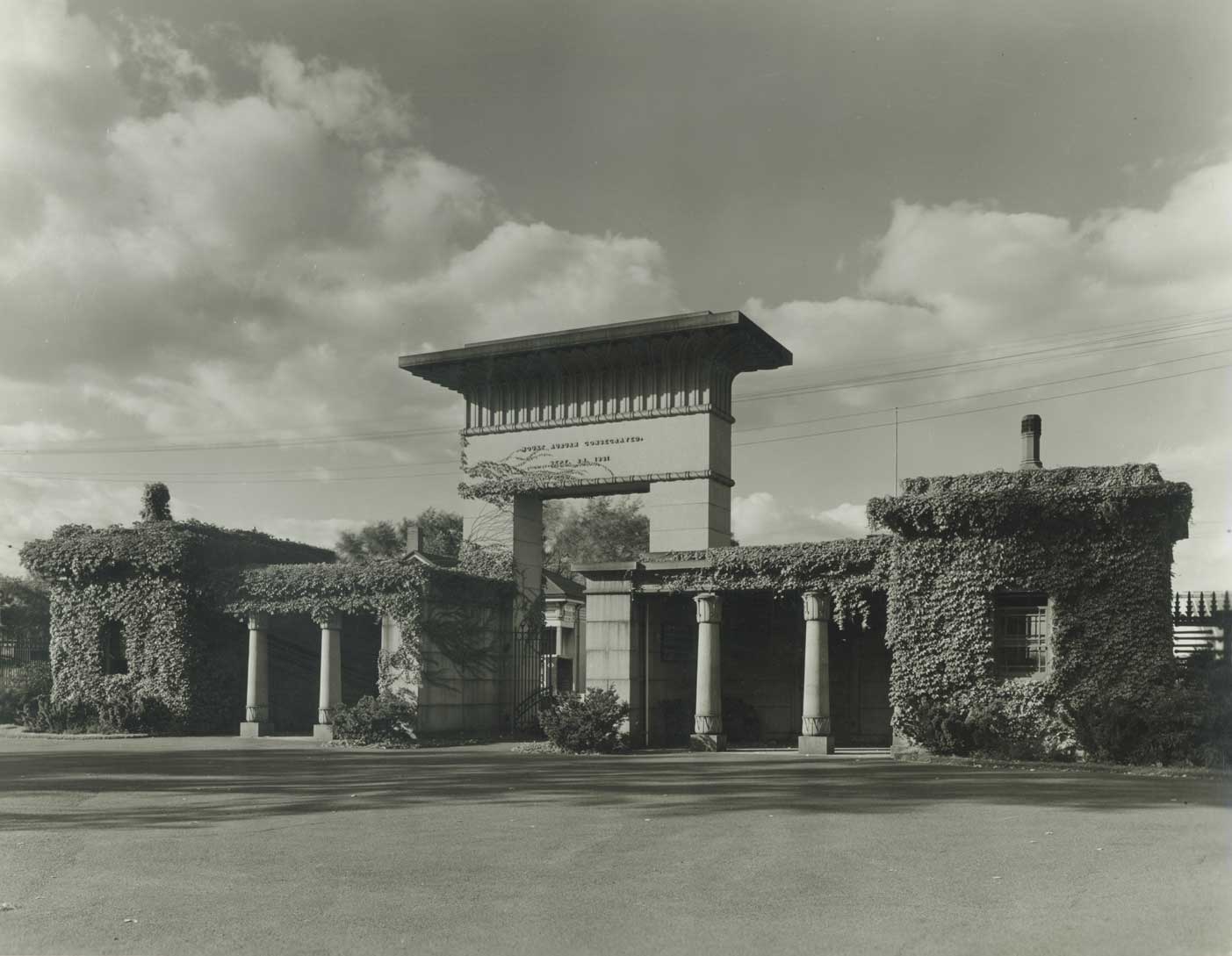
Horticulture and the Gatehouse. Ca. 1945 photographic prints by Arthur C. Haskell. View from inside Mount Auburn.
1936 Landscape alterations include replanting the shrub border along Mount Auburn Street. Iron posts and a broad concrete walk in front of the Gatehouse are replaced with evergreen planting and grass borders that “should help soften the rather harsh aspects of this imposing structure.”
1937 Iron fence painted a bronze green color instead of black.
1975 Mount Auburn Cemetery named to the National Register of Historic Places.
1985 The Friends of Mount Auburn is established. The Friends of Mount Auburn is created to “present Mount Auburn Cemetery to the surrounding community as an historical and natural history resource, and to encourage increased use and enjoyment of the Cemetery as an outdoor museum and classroom for both study and personal reflection” and raises funds for education and preservation efforts.
1992 Ongoing Maintenance. Gatehouse roof is re-caulked and the structure is re-pointed and cleaned.
1993 Mount Auburn Cemetery Master Plan is created by The Halvorson Company of Boston and provides recommendations for preserving the Cemetery’s visual character and historic design intent.
1995 Reconfiguration of roads within the Cemetery at the Gatehouse. Until this time, the entrance road directly abutted the inner alcoves of the Gatehouse. A system of paths and plantings are designed to make the area more inviting and safer for visitors to congregate.
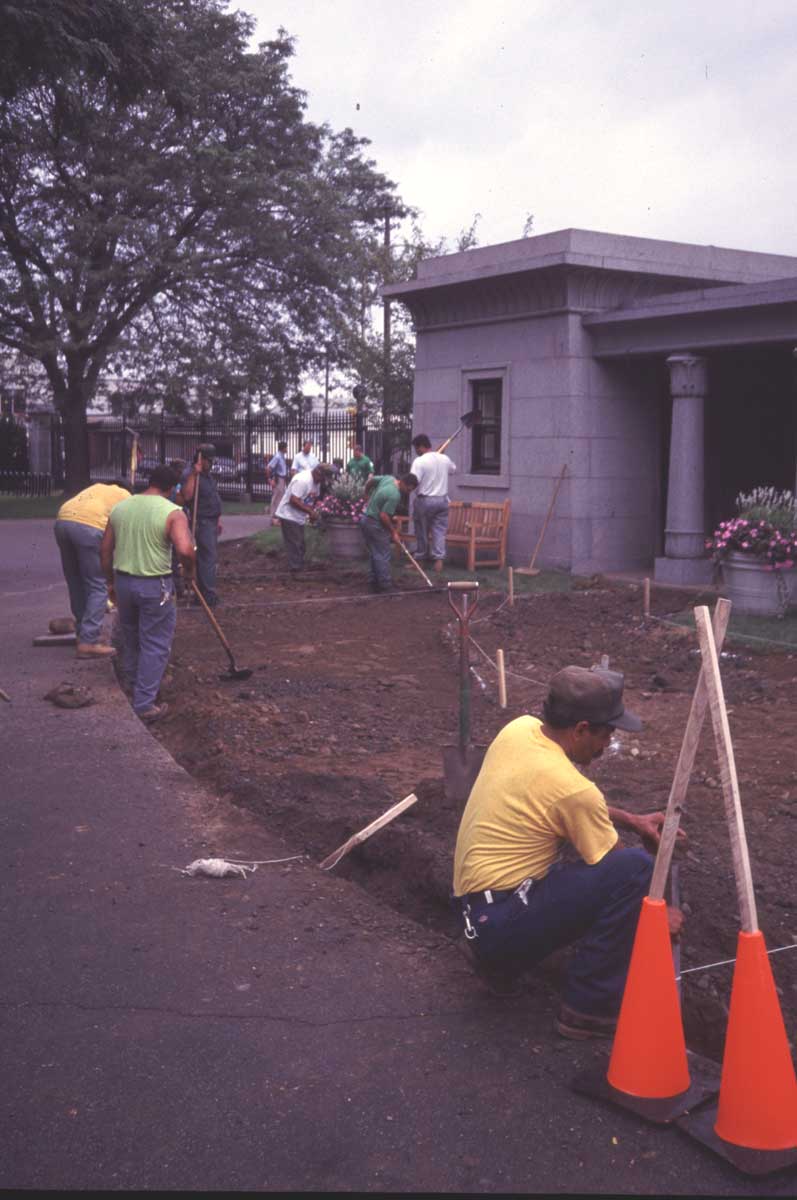
Laying out the new pathway from the Gatehouse into the Cemetery July 1995 photograph.
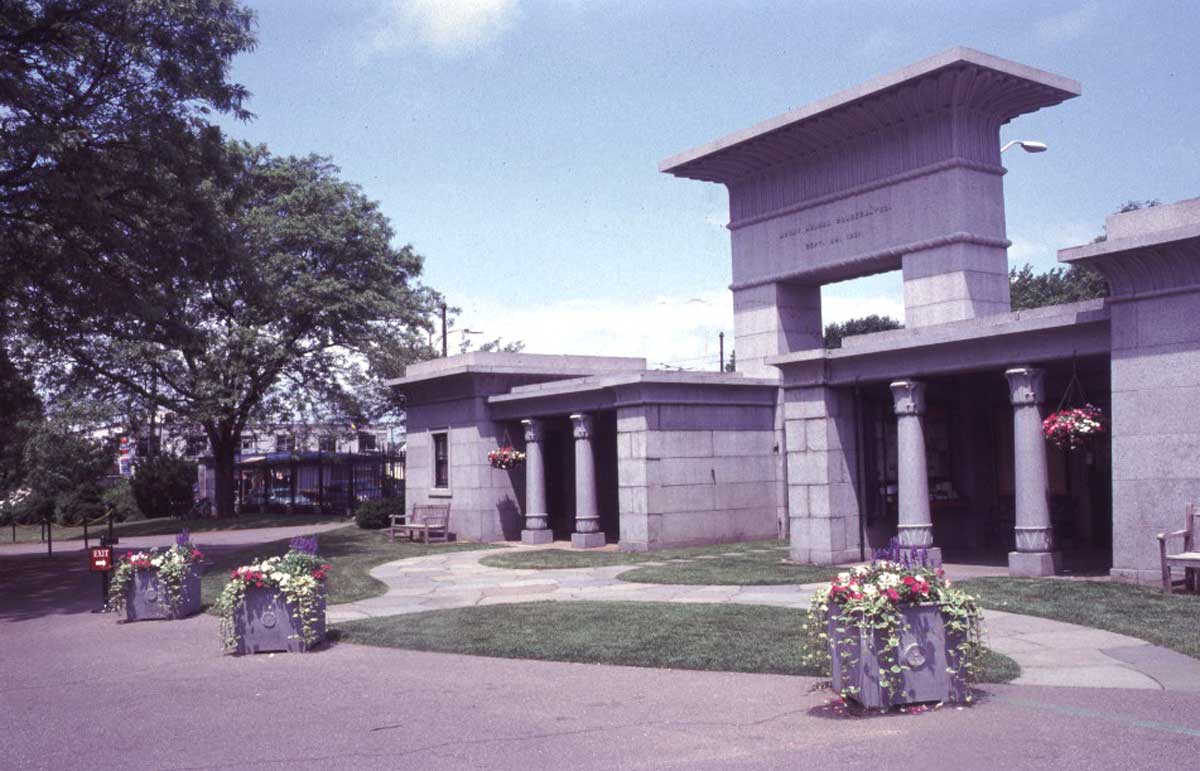
After: June 19, 1997 photograph by Dave Barnett.
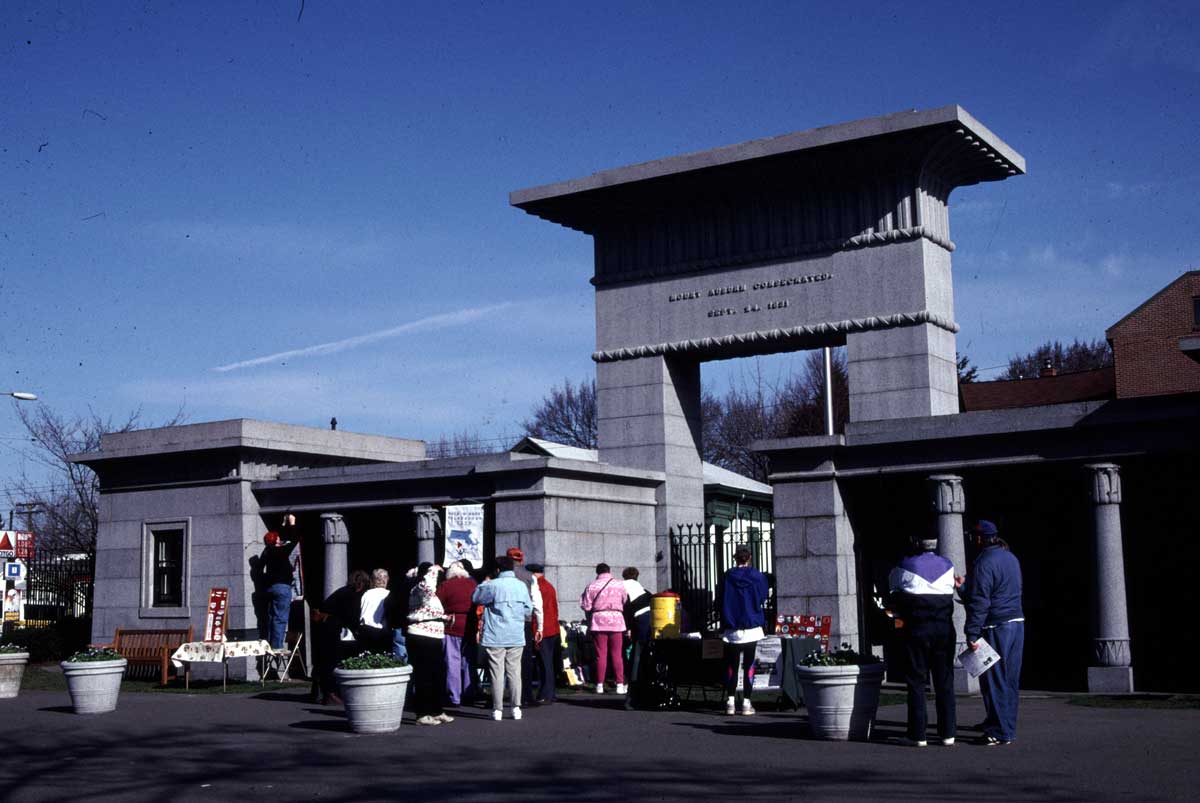
April 4, 1995 photograph by Janet L. Heywood. The Gatehouse continues to serve as a meeting place for Mount Auburn events since the Friends founding.
2003 Mount Auburn Cemetery designated a National Historic Landmark by the Secretary of the Interior.
2006 Gatehouse repaired. Maintenance of the Gatehouse includes re-pointing of mortar joints and repair to damaged stone. National Historic Landmark plaque is added.
2010 Installation of Pilot Visitor Kiosk. Minor upgrades and repairs were completed in the east Gatehouse Lodge to enable installation of a computer kiosk for visitors to lookup burial location.
2014 Comprehensive conditions assessment. The preservation architecture firm McGinley Kalsow & Associates completes assessment of the Egyptian Revival Gatehouse and Cast Iron Fence. The report includes recommendation for full restoration of the fence and additional repair and maintenance to prevent moisture from penetrating the granite structure.
2015-2016 Cast Iron Fence restoration. The remaining sections of historic cast iron fence on either side of the Gatehouse were dismantled and removed for restoration and painting by cast iron repair specialists at Cassidy Brothers Forge. Granite curbing, split by decades of deteriorating embedded iron pickets, was replaced with matching granite. The fence was raised on reinstallation to elevate it above the grade of the sidewalk.
2016 Gatehouse maintenance. The gatehouse was again repointed and roof joints caulked, and dutchman repairs made to damaged original Quincy granite from salvaged stone in the Cemetery's own stock. Woodwork was repaired and repainted, including original doors from the covered alcoves to Mt. Auburn St and windows on the Gatehouse.
2019 and 2023 Entry gate damage. Twice in just over 4 years the gates were struck by vehicles. Damage to the vehicle gates required their removal for straightening, repair and repainting.
2024 New pedestrian gates. Pedestrian gates were installed opposite Aberdeen Ave. and Brattle St. The new pedestrian gates were located to the east and west of the vehicle gates to provide safe entry away from cars for walking visitors to the Cemetery.
2026 Gatehouse exterior repair and maintenance. The gatehouse and alcoves were repointed and recaulked. Windows and doors were repaired and painted.
2026 New Welcome Center. Landscape enhancements include closing a section of roadway and installing a bluestone plaza where visitors can gather and find information at a new Welcome Center in the east alcove. Gift shop to open in the west alcove.
The Gateway as a Gathering Place
The Egyptian Revival Gatehouse was the very first building constructed at Mount Auburn Cemetery in order to welcome visitors. Though it has seen many changes over the years, the Gatehouse remains the face of Mount Auburn, welcoming the Cemetery’s visitors today just as it has since it was first built.
Learn More
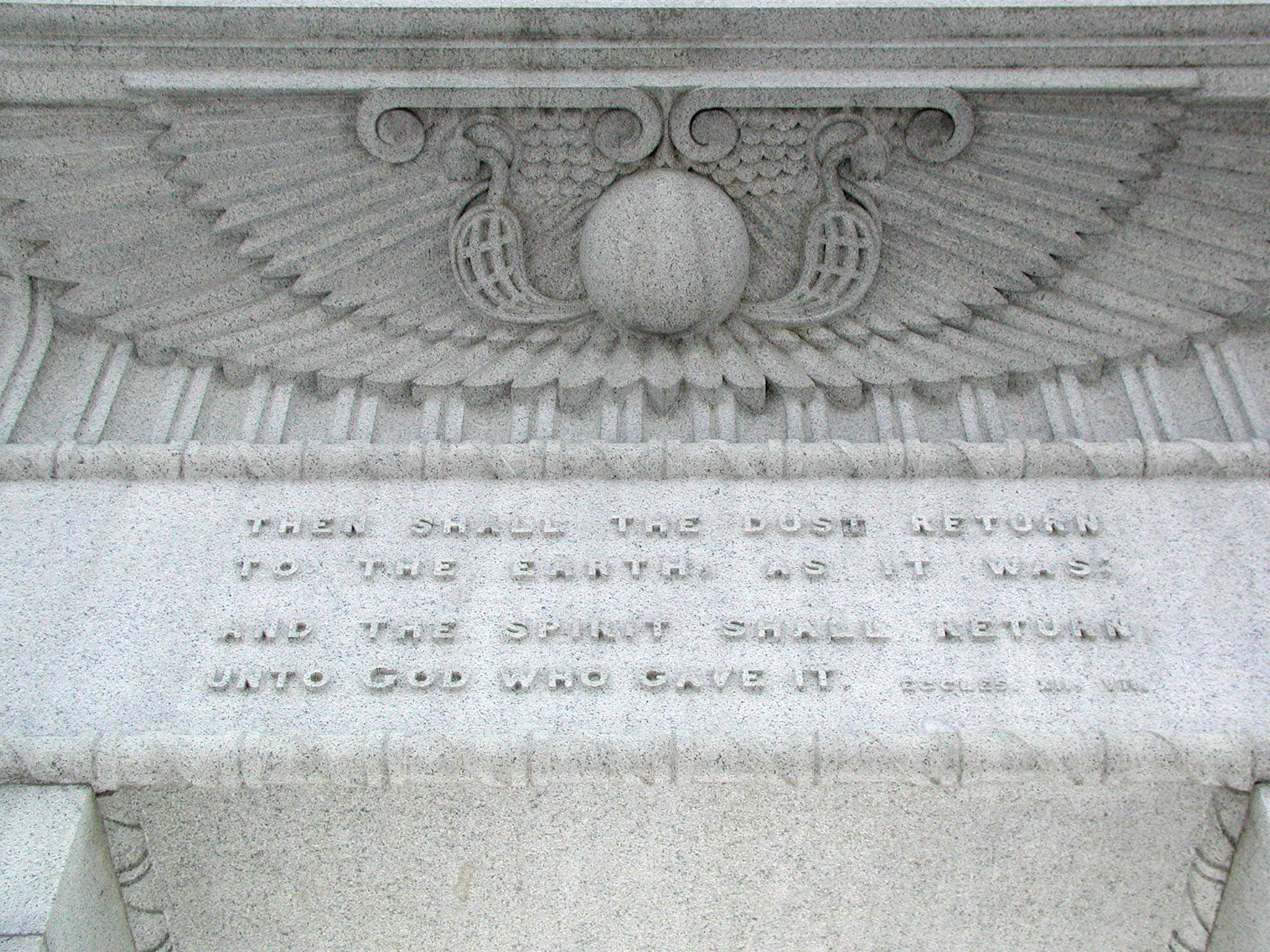
What makes the Gateway an Egyptian Revival structure?
The founders of Mount Auburn drew on the architectural language of ancient cultures to create a sense of timelessness and significance for the Gatehouse. Therefore Dr. Bigelow proposed that, “the principal entrance to Mount Auburn will be through a lofty Egyptian gateway.”
Virtually all of the Gatehouse’s features were inspired by ancient Egypt:
- Battered, or sloped, walls
- Rounded moldings that look like rope
- Columns with a lotus flower capital
- Gorge-and-roll cornice
- Flat roofs
- Two obelisks flank the Gatehouse
- Monumental masonry
Mount Auburn's Gateway Inspires Others
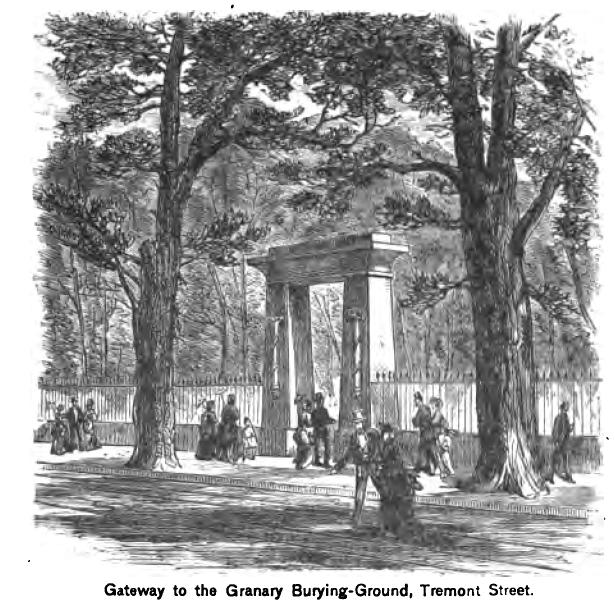
Boston architect Isaiah Rogers designs a small Egyptian gate, constructed of Quincy granite, for the Old Granary Burying Ground in Boston and another for Touro Jewish Cemetery in Newport, RI. An Egyptian gate is also constructed out of Red Sandstone at Grove St. Cemetery in New Haven.
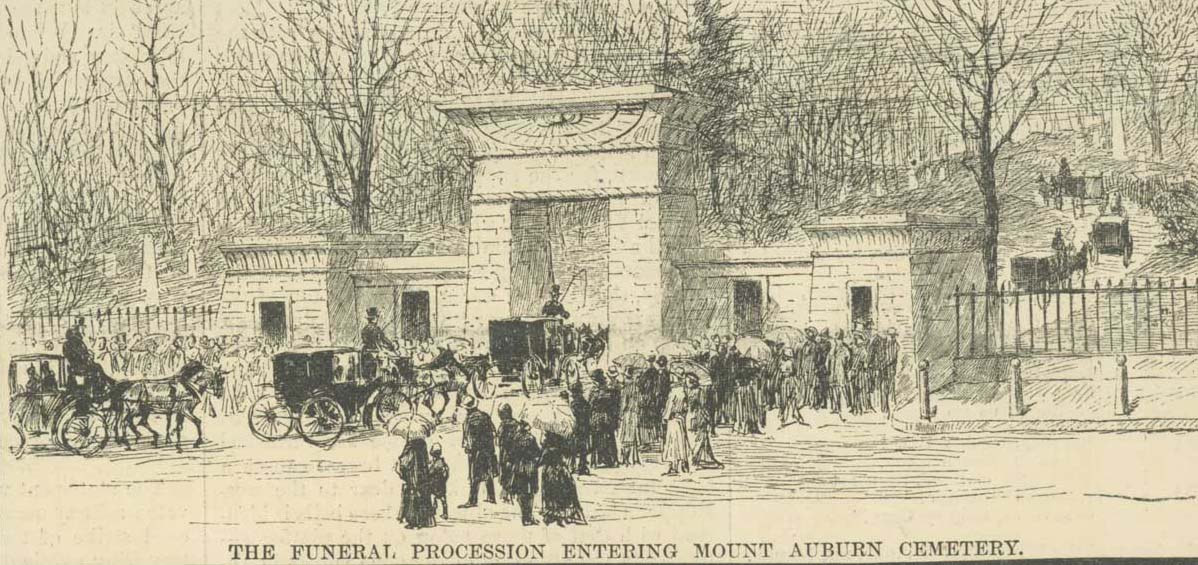
Passing through the Threshold
The Funeral of Henry W. Longfellow. April 8, 1882 from sketches by Edmund H. Garrett in Harper’s Weekly. The Egyptian Revival Gateway is still gathering point for most families attending a burial.
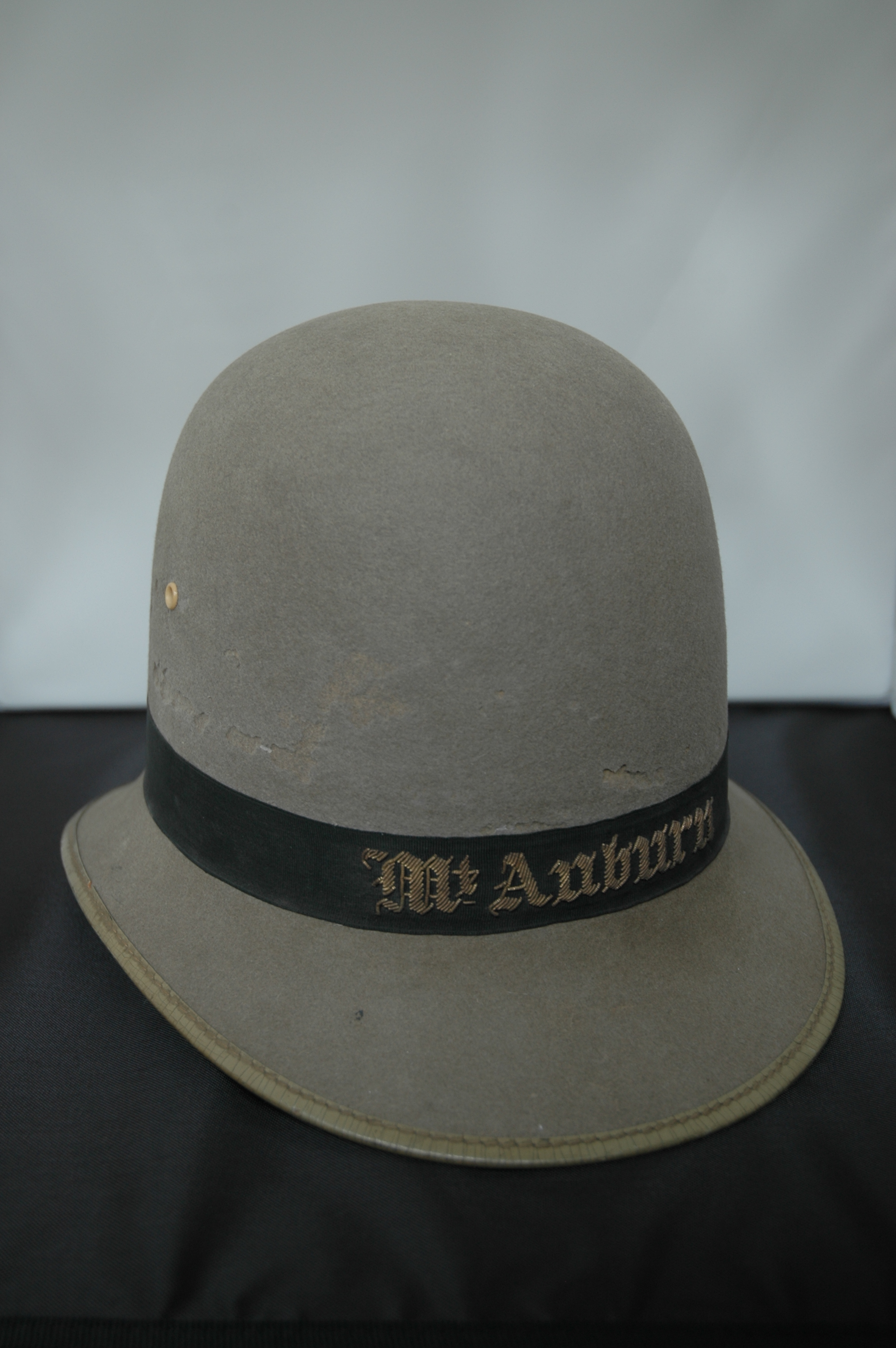
The Man with the Key
In the 19th century there was a Gatekeeper stationed at the entrance to Mount Auburn. He was in charge of taking entry tickets from proprietors, which were required at that time, and ringing the bell to signal the opening and closing of the Cemetery.
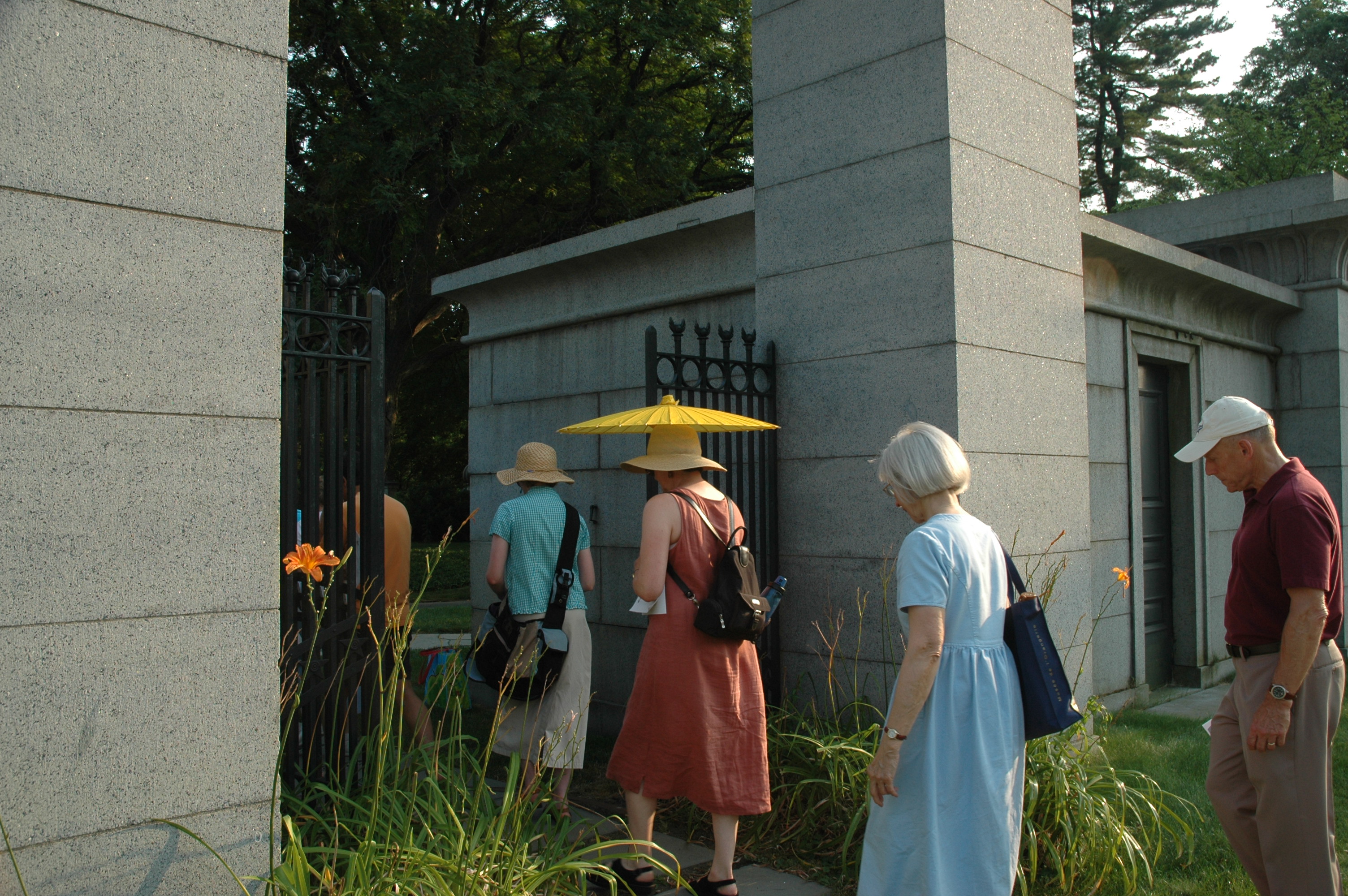
An Iconic Entry
Visitors Entering through the center gate, 2010. We hope you will visit soon!